


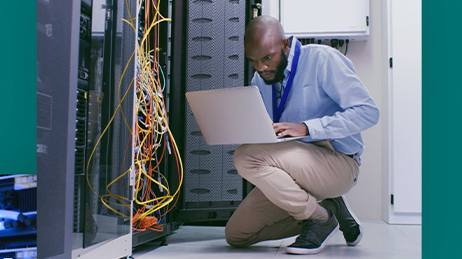




The system running your core transactions today was built for reliability, security, and scale. Those were deliberate engineering decisions, refined over many years, and they are exactly why it's still running, and why the smartest modernization plans build around it.
That’s the logic behind a more practical modernization path: keep the trusted transaction platform at the center, then apply AI around the core to sharpen insight, speed up response, strengthen service, and support growth.
Mission-critical platforms deliver the resilience, security, integrity, and scale that businesses depend on. AI can add to that value by improving the experiences and operating environments that surround the core, without putting the systems that run the business at risk.
Why the trusted core still matters
Across industries, core platforms like ClearPath remain the execution systems for business processes, claims, payments, reservations, logistics, public services, and other essential operations. That staying power reflects decades of proven performance under pressure.
Mainframe-class environments process high volumes with consistency, support strict controls, and deliver the operational dependability that digital businesses need. In a climate shaped by cyber risk, regulatory scrutiny, and nonstop customer expectations, those qualities matter more than ever.
The modernization story is shifting
A selective pattern is taking hold across large organizations: keep the mainframe for high-value workloads because of cost efficiency, security, availability, scalability, and digital transformation needs. IDC's June 2025 survey of 510 mainframe decision-makers found that AI has become the top factor shaping enterprise mainframe investment plans over the next two years, even as companies work through data integration, scalability, and skills challenges. Core technology remains deeply embedded in large enterprises, and AI is changing the economics of modernization by speeding up analysis, remediation, and transformation. Modernization can augment the core in smarter ways instead of replacing it outright.
That shift is changing the modernization playbook. Migrating entire workloads can add cost, complexity, and operational risk. A more disciplined strategy preserves what already works, augments and modifies what creates friction, and introduces new capabilities where the business value shows up quickly. That approach lines up technology decisions with business continuity, financial discipline, and customer expectations.
Where AI creates the most value around the core
For many enterprises, the strongest opportunity sits just outside the core environment. The trusted platform stays the system of record and transaction execution, while AI-enabled services extend the value of core data, processes, and events.
High-value use cases include intelligent customer service, fraud detection, document understanding, developer assistance, operations insights, anomaly detection, testing support, compliance monitoring, and workflow orchestration. Progress can begin without affecting business-critical processing, making the path to modernization more credible and easier to sustain.
AI-ready infrastructure is now a top priority for organizations exploring how AI and mainframe environments can work together to improve responsiveness and utility. Enterprises are increasingly using AI for performance optimization, fraud detection, and security testing in mainframe-centric environments, while favoring more agile modernization programs.
An emerging modernization framework is taking shape around operational excellence, technology acceleration, talent transformation, and risk and compliance governance. Generative and agentic AI can meaningfully improve productivity by helping teams analyze code, uncover dependencies, and make changes with less cost and less resource intensity.
Safe implementation starts with clear boundaries
The core environment keeps handling trusted transactions, records, and controls. AI services operate as adjacent intelligence layers that consume approved data, watch events, assist users, and recommend or automate select actions. APIs, event streams, secure data services, and governed integration patterns build the bridge between operational resilience and modern digital experiences. That design turns modernization into a genuine business advantage supported by the solid mainframe foundation.
Business leaders, technology teams, and implementation partners can apply a few shared disciplines to keep outcomes on track:
- Start with use cases that deliver value quickly and carry limited operational risk.
- Set up governance for data access, model usage, auditability, human oversight, and compliance.
- Modernize integration layers so AI services can reach trusted signals from the core without bypassing control points.
- Move in deliberate steps, testing and adjusting along the way rather than committing to one high-stakes cutover.
These disciplines add up to something bigger than any single project: a steady, repeatable way to modernize around the core, one confident step at a time.
Security, governance, and growth have to move together
AI raises the bar on discipline. As advanced analytics, generative AI, and automation connect to core business processes, security architecture, access controls, model governance, and traceability become the decisive factors. Sensitive transactions can stay in hardened environments, while AI services enrich decisions, summarize information, detect anomalies, and automate surrounding processes under controlled conditions. Growth depends on trust as much as speed.
For leadership teams, the goal goes beyond technical modernization: stronger business performance. An AI strategy built around the core can improve customer responsiveness, increase operational visibility, speed up change, and support new forms of service, while the trusted core safeguards execution. Getting there takes coordination across business, technology, and delivery partners, each contributing a different piece of the outcome.
How Unisys helps enterprises modernize the right way
Getting this right takes a partner who understands your existing core environment, your risk tolerance, and your regulatory requirements and who can help you decide which AI use cases are worth pursuing first. It also helps you explore post-quantum cryptography, serverless architecture, and other next-gen compute possibilities.
That's what Unisys' decades of experience with core systems, data, and security make possible: a clearer path to the value you're after, whether that's faster service, stronger governance, or new AI capabilities built around the systems you already trust.
Ready to modernize with confidence?


